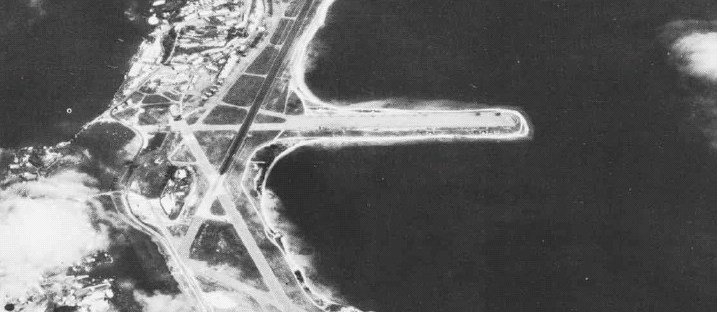
When it comes to spending your time in the Service on a remote island during World War II, I would wager that most folks first think of the Pacific Theater. However, the American military boasted a robust presence in the Atlantic as well, including places like Bermuda and the Azores. Based on his handwriting, it appears this sender served as his own censor before sending this postcard to Delaware in mid-1941. The Lend-Lease policy would have been the dominant policy at the time, prior to the Attack on Pearl Harbor and the United States’ subsequent official entry into World War II in December of 1941. Continue reading “When you come to Bermuda [1941 – Bermuda]”→
Though occasionally vacation postcards can be entertaining, they often contain the most ironically mundane commentary regarding the weather or scheduling. I find the most interesting postcards are the ones that involve births, deaths, marriages, relocations, war, homecomings, graduations, illness, and even lost pets. Those are the ones where I find the most interesting tidbits of individual humanity and anthropology on a larger scale.
An article published in 2005 by the U.S. National Library of Medicine notes “Not only can the illustrations on postcards reveal a considerable amount of information about hospitals in the early twentieth century, but the messages, addresses, postmarks, and stamps can also offer a glimpse of the lives of ordinary citizens and their perceptions of the health care system.” (https://www.ncbi.nlm.nih.gov/pmc/articles/PMC1175805/)
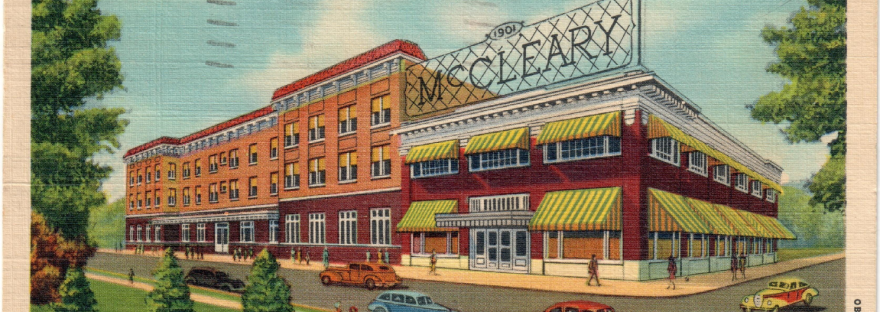
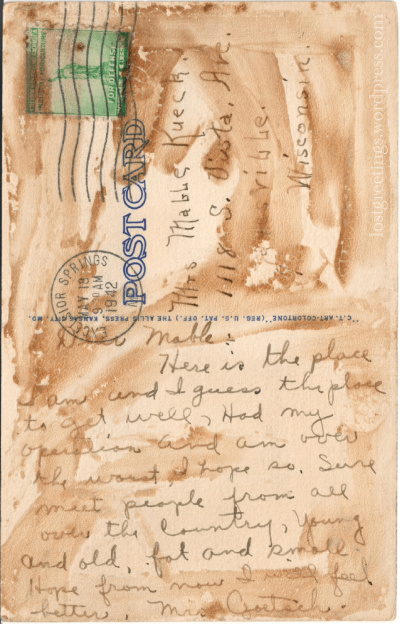
Here we read about one such hospital experience. The sender expresses relief in having made it through surgery, and makes note of the diversity of her fellow patients inside McCleary Hospital near Kansas City, Missouri. I think most people have mixed feelings about hospitals — perhaps, not thrilled about yourself or a family member falling ill, but grateful to have a hospital where you can seek care. I’m glad that Mrs. Goetsch seems to have had a mostly positive hospital stay.
Dear Mable,
Here is the place I am and I guess the place to get well. Had my operation and am over the worst I hope so. Sure meet people from all over the country, young and old, fat and small. Hope from now I will feel better.
Mrs. Goetsch
Postmark: Excelsior Springs, Missouri – May 18, 1942
To: Mrs. Mable Kueck – Janesville, Wisconsin
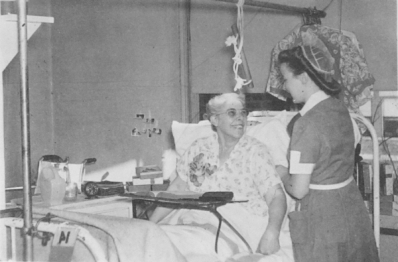
Patient receiving care in Kansas City, Missouri in 1948. Flickr, The Commons
McCleary Thornton Minor Hospital
McCleary Clinic and Hospital remains in existence as McCleary – Thornton – Minor Hospital in Excelsior Springs.
Based on how it’s referenced in this note, I can only imagine how the stationary Virginia used in her previous correspondence to Bernice must have looked. Apparently duty in Fort Myers, Florida is not all sun-bathing and nights on the town. Working Kitchen Patrol all night, which is what I can only assume the sender means by K.P., does not sound like a pleasant way to pass the time. It seems Bernice survived the nighttime duty though. I hope he did get a glimpse of a bathing beauty before leaving the Sunshine State.
The place of origin for this card, expansive Buckingham Army Airfield located near Fort Myers, Florida was in operation from 1942-1945. Known for its “Flexible Gunnery School,” the installation provided a variety of new technologies for training aerial gunners including sophisticated gunnery ranges, dummy target aircraft, dummy ammunition, and high-altitude training. If you want to learn more about all of the fascinating military training methods that were pioneered at this airfield, I highly recommend the Wikipedia page. (Source: Buckingham Army Airfield Wikipedia)
For better or worse, little remains of the hundreds of buildings and runways that constituted Buckingham Army Airfield. It was closed immediately after the war, was purchased by a land developer, and became a residential area.
Two of the 8 runways survive as a private airfield called Buckingham Field.
Hi There Va.,
Here I am again and a very sleepy chap at that. I just got up after working K.P. all night so you can guess how I feel.
That was some stationary you wrote on the other time. Where in the world does a person think up things like that. It’s straight stuff though. Here is the picture of the bathing beauty but she surely must be in some other part of Fla. I haven’t seen her yet.
Be good.
Bernice
Postmark: Fort Myers, Florida – August 7, 1943
To: Virginia Andrews | 410 Elizabeth Street | Durham, NC
From: Pvt. B. A. Smith, 712th F. G. H. S.
B. A. A. F. Fort Myers, Fla.
Buckingham Army Airfield, Fort Myers, Florida
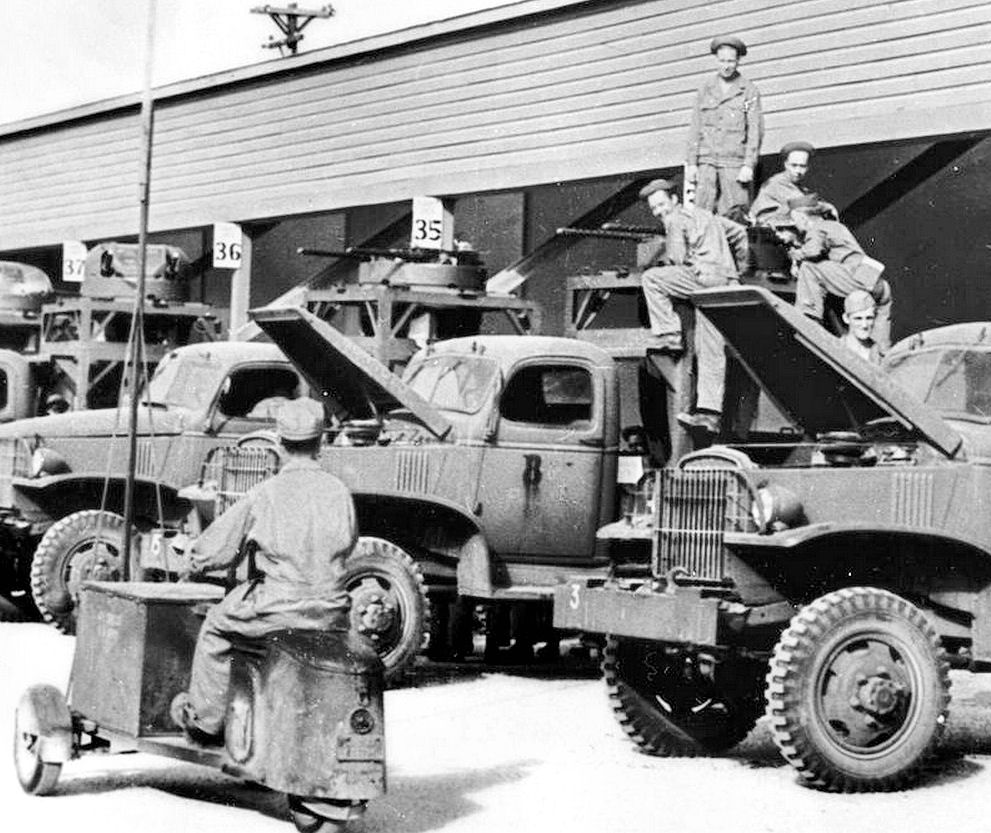
“Photo of the motor pool showing E5 turret training trucks with mounted aircraft turrets used for training.” (Wikipedia)“A formation of four AT-6 aircraft wing their way along the Caloosahatchee River above east Fort Myers to the Buckingham Flexible Gunnery School’s range over the Gulf of Mexico (ca 1945). The plane on the right carries the tow target. The gunners shoot from the rear seat of the planes.” (Wikipedia)
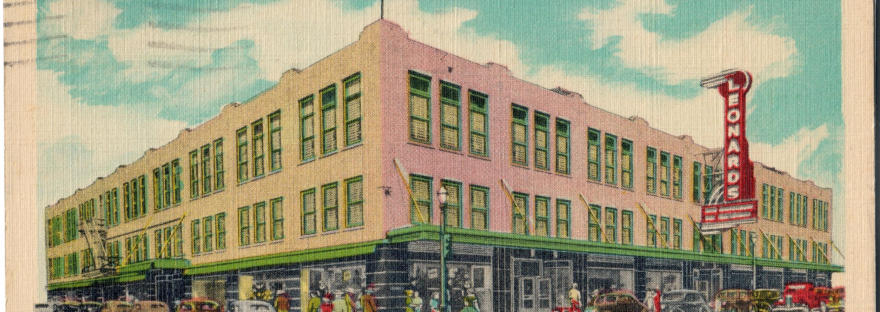
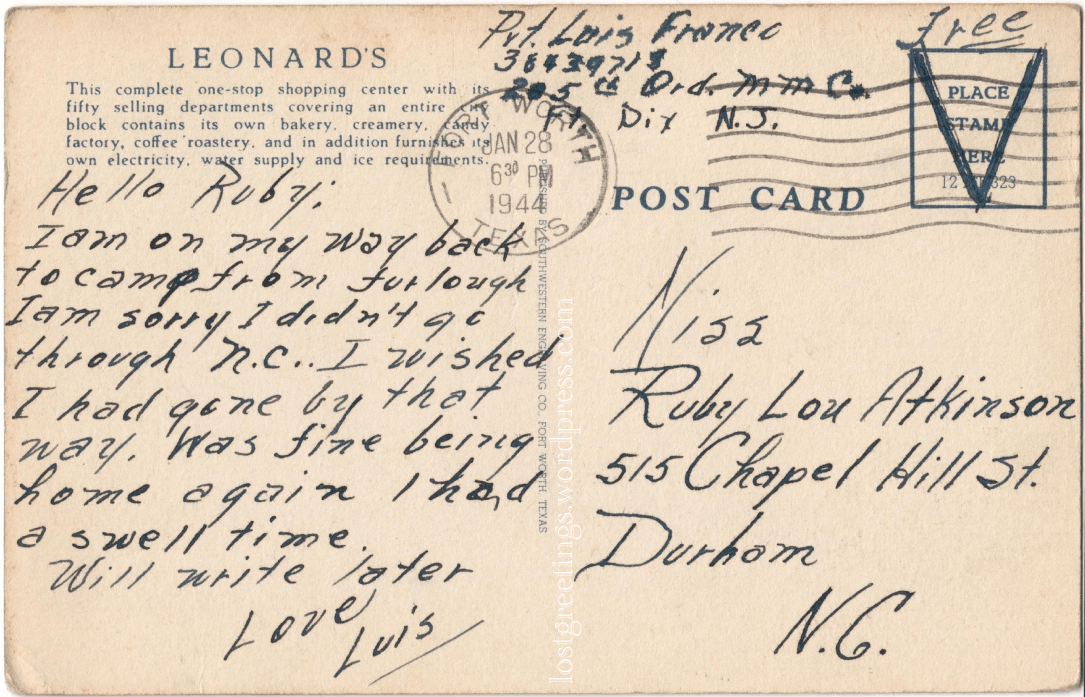
Apparently Leonard’s department store was quite a place to see in its heyday. This store, located in Fort Worth, Texas, was a modern marvel before its time, even including at some point an indoor monorail. I found out about Leonard’s by way of Pvt. Luis France who sent this from Texas to a friend in Durham, North Carolina.
Leonard’s is now home to a museum about its spectacular history.
Hello Ruby,
I am on my way back to camp from furlough. I am sorry I didn’t go through N.C. I wished I had gone by that way. Was fine being home again. I had a swell time.
Will write later.
Love Luis
Postmark: Fort Worth, Texas – Jan 28, 1944
To: Miss Ruby Lou Atkinson | 515 Chapel Hill St. | Durham, N.C.
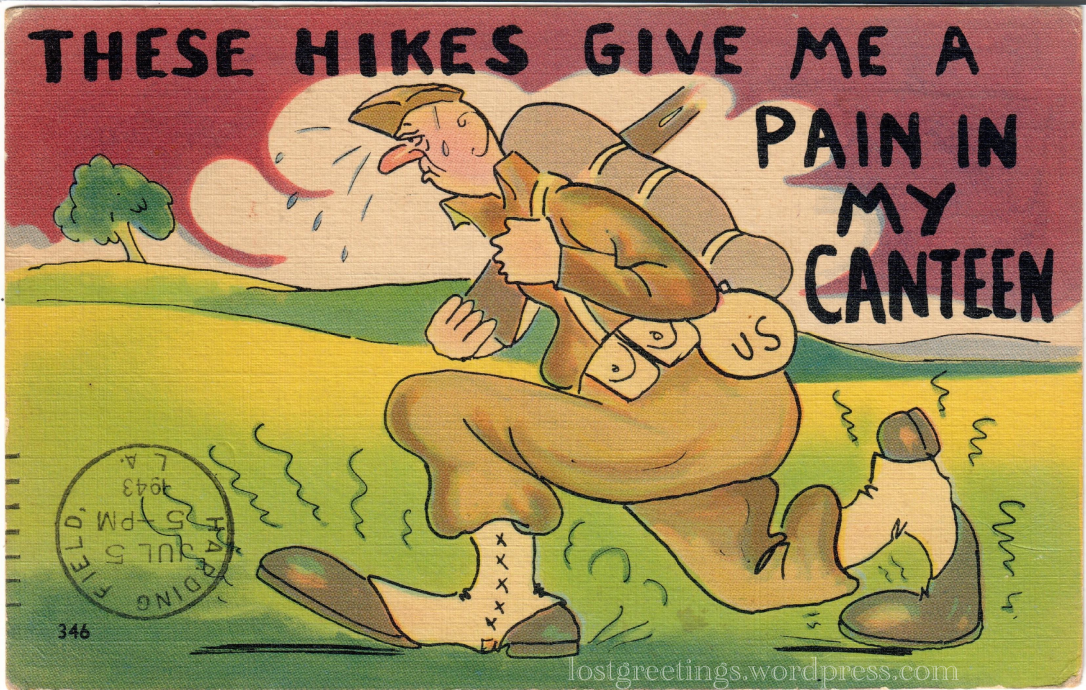
Correspondence between a Private First Class (PFC) and a Private (PVT), this comic postcard from the 1940’s was sent not once, but twice! And, there are 2 postmarks and 4 separate locations involved:
It would be interesting to know whether or not Harry did end up in a desert theater, once he was deployed overseas.
Dear Homer,
How did it feel to get back to army life after your furlough. I expect it was lot of fun. I am learning to be a soldier now and maybe I’ll make a good one sometime. It is hot down here and so I ought to be able to stand desert service after this training is over.
Answer soon. Harry
Sent to: Pfc. Homer E. Baugh
1590th 318 [?] S. G.
Barksdale Field, Louisiana
Sent by: Pvt Harry Hawkins
Battery B 195 A. A. A. A. W. Bn.
Camp Stewart, Georgia
Postmark: Camp Stewart, Georgia – June 28, 1943
2nd Postmark on the front: Harding Field, Baton Rouge, Louisiana – July 5, 1943
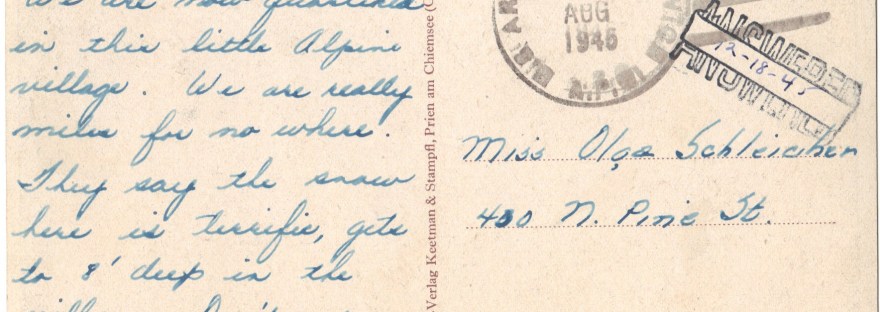
George found himself in a quaint alpine village in the late summer of 1945. The picturesque village of Reit im Winkl is a small German town near the Austrian border with a strong tradition of tourism. No rank or unit is given on this card, but the postcard was stamped at APO 527.
August 17
We are now quartered in this little Alpine village. We are really miles from no where. They say the snow here is terrific gets to 8′ deep in the village. Don’t you think the Alps look beautiful?
George
Postmark: U.S. Army Postal Service A.P.0 572 – 25 Aug 1945
To: Miss Olga Schleichen | 450 N. Pine St. | Indianapolis, Indiana
Image description: Reit im Winkl mit Keisergebirge 2344m
Reit im Winkl
An alpine community in the Southeast corner of modern Germany, to this day, the town has no rail connection (source), but remains a popular destination for winter and summer outdoor sports.
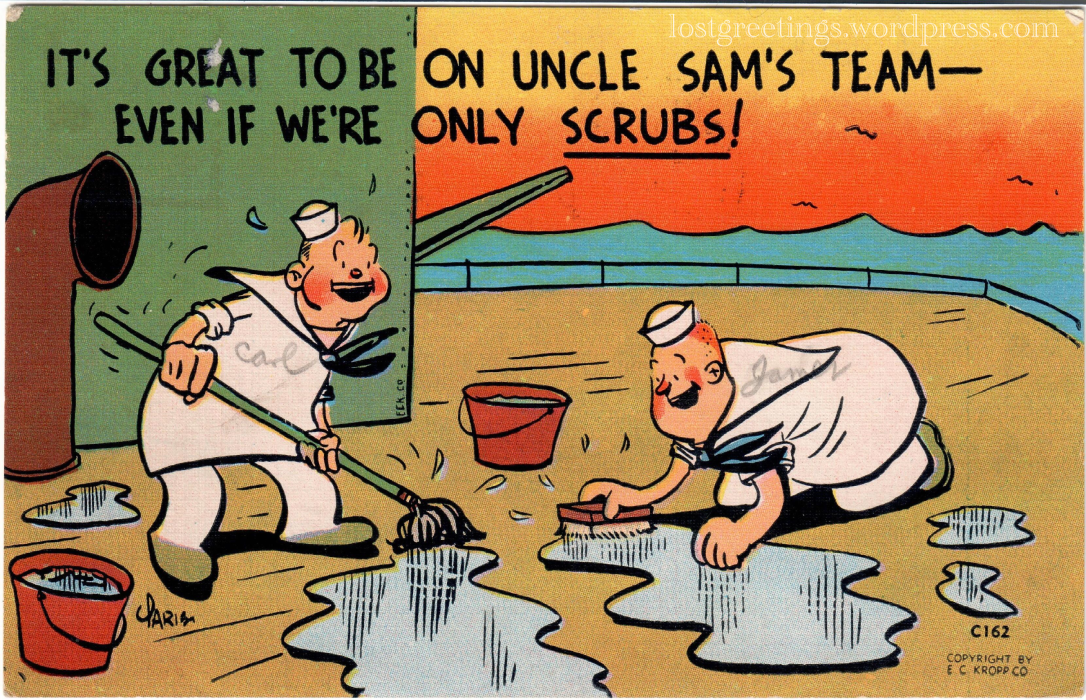
This postcard was sent during the Korean War by what I assume was a junior enlisted sailor. He gives us no details about his assignment other than what we can see from the the San Diego, CA postmark. Carl writes such an endearing note home to his parents in Tennessee. The handwritten names on the cartoon are my favorite part.
Dear Mother and Daddy
How are all of all there fine I hop. I went to church today. It not much to do here today so I thought I would write you a line. I will send you a picture this next weekend. by for now
Carl {?}
To: Mr. Mrs. J. T. Knight
308 Madison St. N
Nashville 8, Tenn
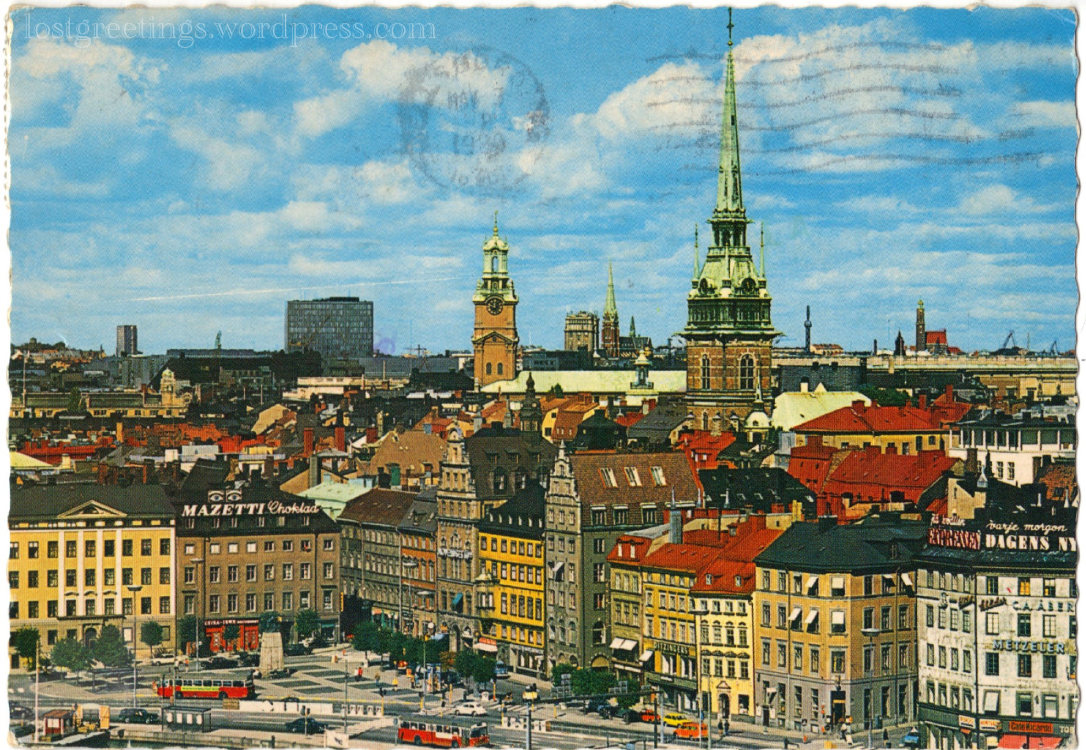
World traveling on a budget isn’t easy, but this family seems to have enjoyed their visit.
This is how we all shared our adventures with friends and family before Facebook and Instagram changed everything, for better or worse.
Dear Sue & Gene,
Thanks for your letter. You’re right Stockholm & Sweden are beautiful. The train ride here was very scenic. Lots of lakes & forests. Dad says it reminds him of his uncle’s properties in Canada.
Most of the affordable hotels were full, now we are staying in a private apartment. It has a beautiful view of the City Hall.
Hope spring finds you both well & happy. I know you’ll be busy. “Hello to Jen & Helen”
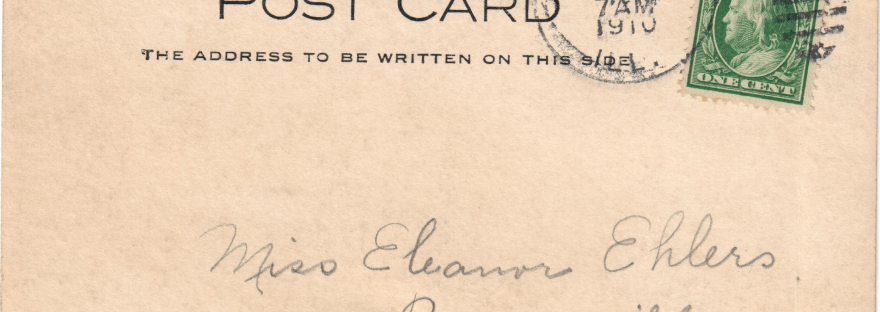
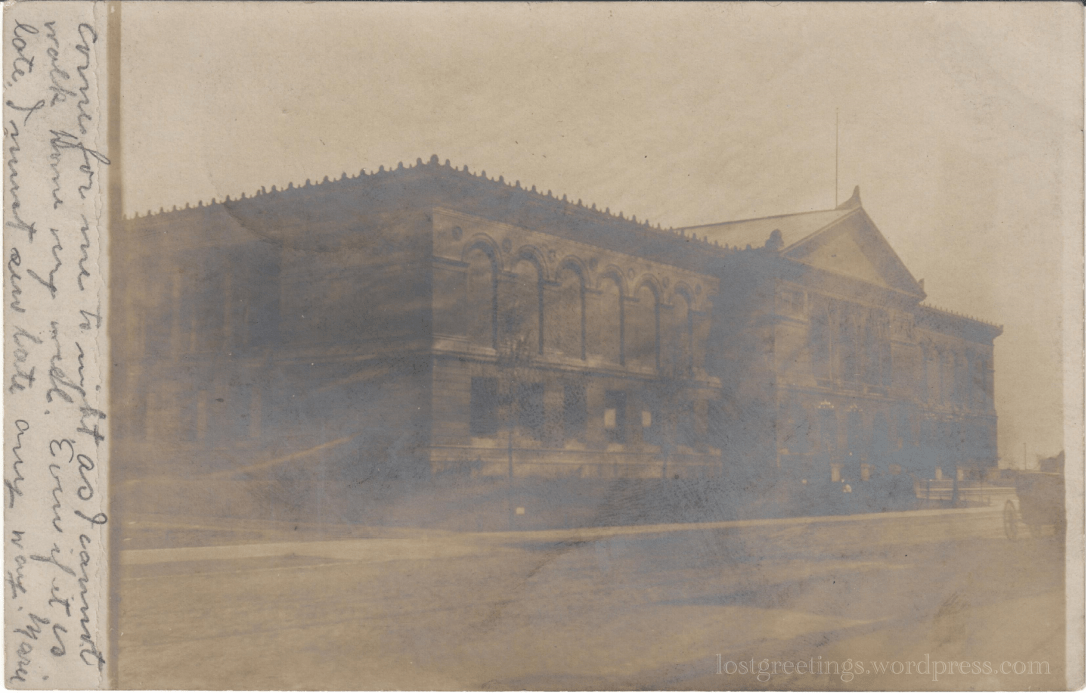
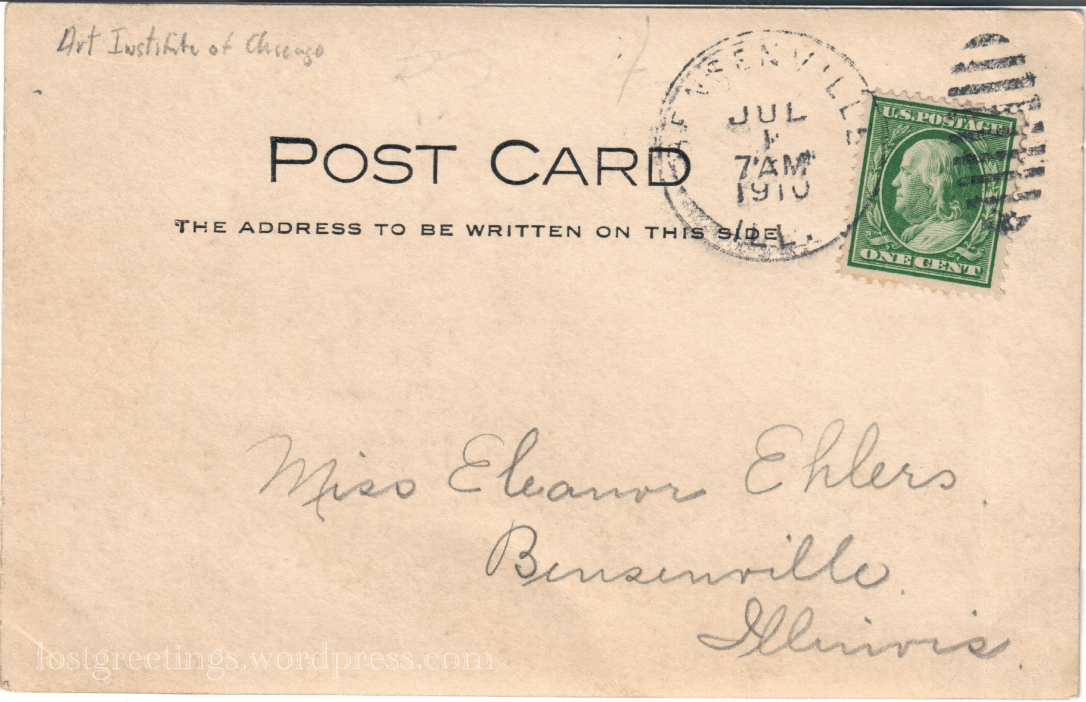
Postcards like this one always prompt me to reflect on how places change over decades. The building pictured is the Art Institute of Chicago, constructed in 1893 for the World’s Columbian Exhibition. The card was postmarked Bensenville, Illinois, which is located near Chicago’s O’Hare International Airport.
This antique photograph postcard reflects an earlier era before the divided back postcard format. The message had to be squeezed on the front and the reverse reserved for the address only.
The place and time where Marie wrote and sent this card seems as distant from our present as our nearest celestial neighbors are from Earth itself. The Chicago of today would be unrecognizable to a 1910 resident, save for monumental landmarks such as this one.
“Come for me to night as I cannot walk home very well. Even if it is late. I must sew late any way. Marie”













 Lost Greetings